What a $25K Unit Renovation Actually Looks Like in the LA Market
Most property owners hear "$25,000 per unit" and picture a full gut renovation. New everything. Down to the studs.
That is not what $25K buys you in Los Angeles. And the gap between what owners expect and what actually happens at that budget is where most renovation projects go wrong.
Either the scope gets cut mid-project because the money runs out. Or the contractor pads the estimate to cover themselves, and the owner ends up paying $25K for $15K worth of work. Or the project drags because nobody defined what was included from the start.
The problem is not the budget. $25K per unit is a realistic, effective renovation budget in the LA market. The problem is that most owners and property managers don't know what $25K should actually buy — so they can't hold anyone accountable when it doesn't.
Here is exactly what a $25K unit renovation looks like, line by line, in a real 2-bed/1-bath unit in the Los Angeles area.

The Scope: What a 25K Unit Renovation in LA Actually Covers
This is a realistic scope for a cosmetic-plus renovation on a 2-bed/1-bath unit in the LA market. Not a full gut. Not a lipstick refresh. The sweet spot in between that delivers measurable rent lift without blowing the budget.
Flooring — $3,500-4,500
Remove existing flooring (carpet, tile, or linoleum) and install LVP (luxury vinyl plank) throughout the unit. LVP is the standard for multifamily renovations because it holds up to tenant wear, is water-resistant, and looks modern. Carpet is no longer competitive in this market — tenants expect hard surface flooring.
Kitchen — $5,500-7,000
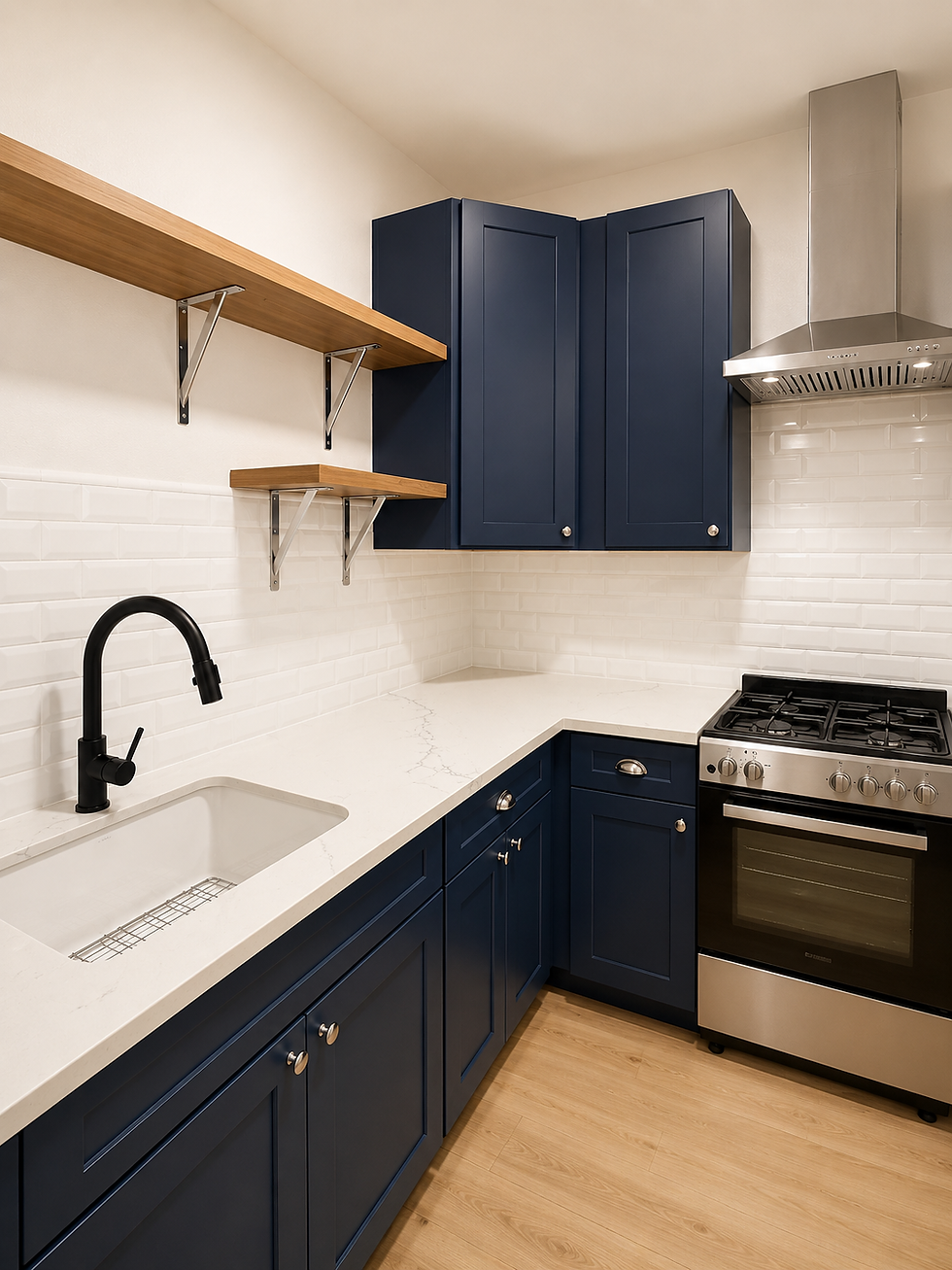
This is where most of the perceived value lives. The scope includes: new cabinet faces or refinished cabinets, new hardware (pulls and knobs), new countertops (quartz or solid surface — laminate is losing competitiveness), new backsplash, updated faucet, and new light fixture. If appliances are visibly dated, replace the range and dishwasher. The refrigerator usually stays unless it's failing.
This is not a full kitchen gut. The cabinet boxes stay. The plumbing stays in place. The layout stays the same. What changes is everything the tenant sees and touches.
Bathroom — $3,000-4,500
Reglaze the tub and tile surround (or install a new surround if the existing one is damaged beyond reglazing). New vanity or refinished vanity with new countertop. New faucet, new showerhead, new toilet seat, new mirror, new light fixture. Updated hardware and accessories.
Again — not a full bathroom gut. The tub stays. The plumbing stays in place. What changes is everything visible.
Paint — $2,000-2,800
Full interior paint: walls, ceilings, trim, baseboards, doors. Two coats minimum. Modern neutral palette (warm whites and light grays are standard — anything with yellow or beige undertones reads as dated). Ceiling paint should be flat white. Semi-gloss on trim and doors.
Lighting — $800-1,200
Replace all light fixtures throughout the unit. This is one of the most cost-effective upgrades — a $40 fixture replacement changes the feel of a room more than most people expect. Focus on kitchen, bathroom, and entry. Bedroom fixtures can be basic.
Hardware and Accessories — $400-600
New door handles, cabinet pulls, towel bars, toilet paper holders, door stops. Small details that signal "this unit has been updated." Tenants notice when all the hardware matches and looks current.
Electrical — $500-1,000
Replace outlet covers and switch plates (the yellowed plastic ones are an instant signal of an unrenovated unit). Add USB outlets in key locations (kitchen counter, bedside). Ensure GFCI compliance in kitchen and bathroom.
Doors — $800-1,500
Replace or refinish interior doors if they're hollow-core and visibly damaged. Replace bifold closet doors if they're broken or warped. New doorstops throughout. This is optional depending on condition — if the existing doors are solid and in decent shape, paint them and move on.
Cleaning and Prep — $500-800
Professional deep clean after construction. Window cleaning inside and out. Pressure wash patio or balcony if applicable.
Contingency — $1,000-1,500
Every renovation uncovers something. A plumbing issue behind the wall. Subfloor damage under the old flooring. Electrical that doesn't meet code. Build 5-8% contingency into the budget or you'll be over budget on every project.
The Total
Add it up:
Flooring: $3,500-4,500
Kitchen: $5,500-7,000
Bathroom: $3,000-4,500
Paint: $2,000-2,800
Lighting: $800-1,200
Hardware: $400-600
Electrical: $500-1,000
Doors: $800-1,500
Cleaning: $500-800
Contingency: $1,000-1,500
Total range: $18,500-25,400
The lower end gets you a clean, modern, competitive unit. The higher end gets you a unit that competes with newer construction in the submarket. Both deliver rent lift — the question is how much you want to push the ceiling.
What This Does NOT Include
Being clear about what's outside the $25K scope prevents the most common renovation conflicts:
Full kitchen gut (moving plumbing, new cabinet boxes, new layout): add $8,000-12,000
Full bathroom gut (new tub, new tile, moving plumbing): add $5,000-8,000
HVAC replacement: $4,000-7,000
Window replacement: $3,000-6,000 depending on unit size
Washer/dryer hookup addition: $2,500-4,000
Structural work, water damage remediation, mold: varies widely
If any of these are needed, you're looking at a $35K-50K+ renovation, not $25K. Knowing this upfront prevents the mid-project budget surprise that kills timelines and trust.
The ROI: What You Get Back
A $25K renovation on a 2-bed/1-bath in the LA market typically delivers:
Rent lift: $300-500/month depending on submarket and existing rent level. In stronger submarkets (West LA, South Bay, parts of the Valley), the lift can push higher. In softer markets, $250-350 is more realistic.
At $350/month rent lift:
Annual additional revenue: $4,200
Payback period: 5.9 years
At a 5-cap, that rent lift adds $84,000 in asset value per unit
At $500/month rent lift:
Annual additional revenue: $6,000
Payback period: 4.2 years
At a 5-cap, that rent lift adds $120,000 in asset value per unit
Multiply across 10 units:
$350/mo lift x 10 units = $42,000/year additional revenue
$250K renovation investment
Asset value increase: $840,000 at a 5-cap
The renovation pays for itself in under 6 years and immediately increases the property's market value by 3-4x the renovation cost.
The Mistakes That Kill a $25K Renovation
Mistake 1: No defined scope before starting.If the contractor doesn't have a line-by-line scope, they'll make decisions for you. Those decisions will either cut quality or add cost. Define every item before the first day of work.
Mistake 2: Choosing finishes that don't match the submarket.Quartz countertops in a C-class building in a C-class neighborhood won't return the investment. LVP flooring in an A-class building in an A-class neighborhood looks cheap. Match the renovation to the market.
Mistake 3: No contingency budget.Every unit has surprises. If your budget is $25K with zero contingency, your real budget is $23K of scope and $2K of stress.
Mistake 4: Renovating vacant units only.If you only renovate when a unit turns over, you're spending money to attract new tenants instead of keeping the ones you have. Offer existing tenants a renovation package in exchange for a longer lease at a modest increase.
Mistake 5: Hiring a contractor who doesn't do multifamily.A residential remodel contractor prices and operates differently than a multifamily renovation contractor. Multifamily work requires coordinating around occupied units, phasing multiple renovations, and understanding the economics of rental properties. If your contractor's experience is kitchens in single-family homes, they're learning on your dime.
What to Ask Your Contractor
Before signing a contract for a $25K unit renovation, ask these questions:
"Can you give me a line-by-line breakdown that matches this scope?" — If the answer is a lump sum with no detail, that's a red flag.
"What's your typical timeline for this scope on a 2-bed unit?" — A realistic answer is 10-14 working days for a cosmetic-plus renovation. If they say 3-4 weeks, they're either padding or don't have dedicated crews.
"How do you handle surprises that come up during the work?" — The right answer involves documenting the issue, communicating immediately, and providing a revised cost before proceeding.
"How many units like this have you done in the last 12 months?" — Volume matters. A contractor who does 5+ units per month has systems. A contractor who does 2 per quarter is figuring it out.
The Bottom Line
$25K per unit is not a guess. It's a budget that works when the scope is defined, the finishes match the market, and the contractor knows what they're doing.
The property managers who get the best results from this budget are the ones who define every line item before construction starts, build in contingency for the unexpected, and measure the renovation against rent lift and asset value — not just how the unit looks.
Diamond Pro Apartment Experts handles unit renovations across Southern California for multifamily and commercial property managers. We work at this budget range daily and can provide line-by-line scoping, timeline commitments, and ROI projections for your specific property.
Get in touch at info@diamondgcinc.com to talk through your next renovation.


Comments